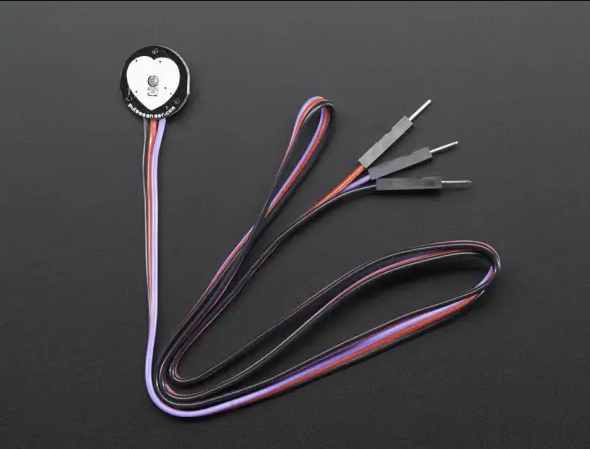
The pulse heart rate sensor is an optical sensor that uses Photoplethysmography (PPG) technology to detect blood volume changes in the finger or earlobe . It works by shining a light and measuring the reflected or transmitted light, creating a waveform that corresponds to each heartbeat . This plugandplay module is widely used in wearable devices, fitness projects, and biomedical prototyping with Arduino and other microcontrollers .
| Parameter | Value |
|---|---|
| Sensor Type | Optical PPG (Photoplethysmogram) |
| Operating Voltage | 3V to 5V DC |
| Current Draw | ~4mA |
| Output Type | Analog signal (connect to ADC pin) |
| Interface | 3-Pin: VCC, GND, Signal |
| Working Principle | LED (Green/IR) + Phototransistor/Photosensor |
+Simple & PlugandPlay - Connects directly to Arduino with standard male headers
+Versatile Applications - Used in smartwatches, fitness bands, and DIY health projects
+Noise Cancellation Circuitry - Many modules include amplification for reliable pulse readings
+Multiple Mounting Options - Can be used with ear clip, finger strap, or tape
+Wide Compatibility Works with Arduino, ESP32, and other 3.3V5V microcontrollers
√ Compatible with Arduino, ESP32, Raspberry Pi, and other MCUs
√ Ideal for student projects, hobbyists, and prototyping
| Sensor Pin | Arduino Pin | Function |
|---|---|---|
| VCC | 3.3V or 5V | Power supply |
| GND | GND | Ground |
| Signal (S/OUT) | A0 (Analog) | Analog signal output |
No signal or weak signal:
Unstable or noisy waveform:
| Important Health Disclaimer | This sensor is intended for educational and hobby projects only. It is not a medical device and should not be used for diagnosis or treatment . For accurate health data, please consult a medical professional. |