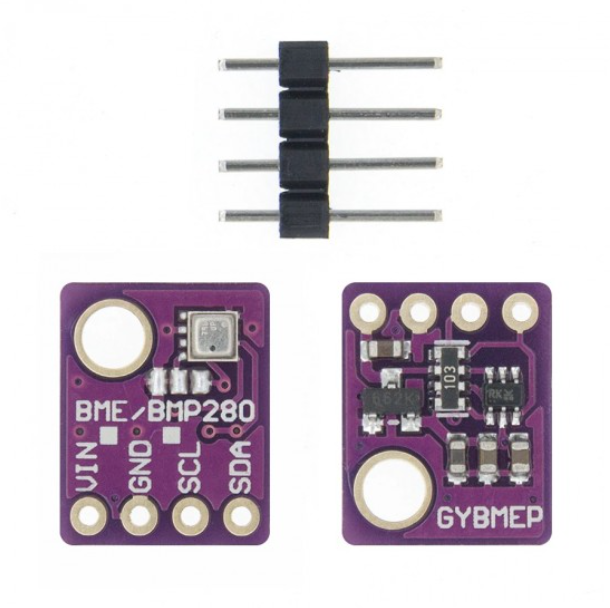
The BME280 is an integrated environmental digital sensor designed by Bosch Sensortec, capable of simultaneously measuring temperature, humidity, and barometric pressure . It is an ideal choice for weather monitoring, IoT projects, and altimeter applications due to its small size, low power consumption, and long-term stability .
| Parameter | Value |
|---|---|
| Temperature Range | -40°C to +85°C |
| Temperature Accuracy | ±0.5°C (typical) |
| Humidity Range | 0% to 100% RH |
| Humidity Accuracy | ±3% RH |
| Pressure Range | 300 to 1100 hPa |
| Pressure Accuracy | ±1 hPa |
| Pressure Resolution | 0.18 Pa |
| Interface | I2C / SPI |
| I2C Address | 0x76 or 0x77 |
+Combined 20bit ADC Provides high-resolution digital output for all three measurements .
+Individual Factory Calibration - Each sensor is calibrated at the factory, with coefficients stored in internal EEPROM for accurate compensation .
+Dual Communication Protocol - Supports both I2C and SPI, compatible with a wide range of microcontrollers including Arduino, ESP32, and Raspberry Pi .
+Compact Breakout Form Factor - Many modules include onboard voltage level translation, allowing direct connection to both 3.3V and 5V systems .
+Configurable Oversampling Allows adjustment of measurement resolution vs. speed and power consumption tradeoffs .
√ Versatile and widely supported Extensive library support available for Arduino, ESPIDF, Raspberry Pi, and MicroPython .
√ Suitable for altitude and weather calculations Onchip calibration enables accurate pressuretoaltitude conversion .
√ Common breakout designs - Includes mounting holes and pin headers for easy integration into projects .
| Module Pin | Arduino UNO | ESP32 |
|---|---|---|
| VCC | 5V (or 3.3V) | 3.3V |
| GND | GND | GND |
| SDA | A4 | GPIO21 |
| SCL | A5 | GPIO22 |
| SDO/ADDR | GND (0x76) or 3.3V (0x77) |
The I2C address is configured by the voltage on the SDO pin .
No communication:
Inaccurate readings:
 2.png "Buy MQ-5 Gas Sensor Module for KSH 600 – HIMA TRONICS Mombasa – Quality electronics in Mombasa, Kenya")