TCS3200 Color Sensor Module
= Static Color Recognition and Identification for Arduino Projects =
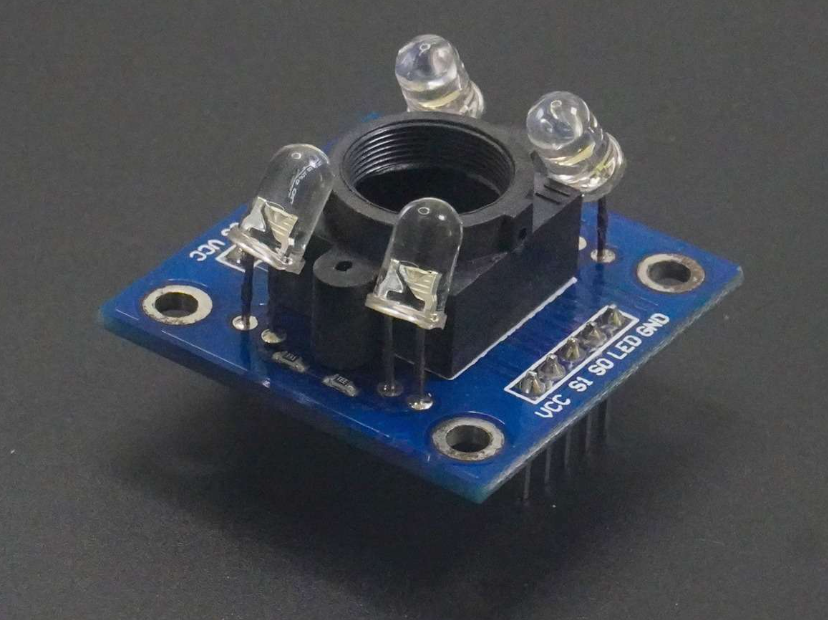
The TCS3200 is a color sensor module that detects and identifies colors by converting light intensity into a variable frequency square wave, making it ideal for color sorting, matching, and environmental sensing projects .
Converts Color to Frequency - Outputs a square wave with frequency directly proportional to light intensity
Adjustable Sensitivity Onboard LEDs for filllight and frequency scaling options
The sensor chip, TCS3200, features an 8x8 array of photodiodes with red, green, blue, and clear filters .
It detects the color of a surface by measuring the reflected light, ideal for color sorting machines, and test strip readers .
Use the pins S0 and S1 to set the output frequency scaling to 2%, 20%, or 100% .
The sensor detects color at a static distance; the recommended detection distance is about 10mm .
= Technical Specifications =
| Parameter | Value |
|---|
| -- | -- |
| Sensor Chip | TCS3200 (RGB color detector) |
| Power Supply | 2.7V to 5.5V (typically 5V) |
| Output | Square Wave (frequency proportional to light intensity) |
| Detection Distance | ~10mm |
| Interface Pins | S0, S1, S2, S3, OUT, LED |
= How to Use It =
The TCS3200 uses frequency scaling and photodiode filtering to measure color components . By selecting different filters (via S2/S3 pins) and scaling (via S0/S1 pins), the sensor's output pin produces a frequency that varies with the intensity of that specific color.
| Pin | Name | Function |
|---|
| -- | -- | -- |
| S0/S1 | Scaling Selection | Set output frequency to 2%, 20%, or 100% |
| S2/S3 | Filter Selection | Select the color filter: RED, GREEN, BLUE, or CLEAR |
| OUT | Frequency Output | Outputs a square wave based on selected color and intensity |
| LED | Fill-Light Control | Enable/disable the onboard white LEDs |
For accurate color measurement, you must perform a white balance calibration each time the module is powered on or the lighting changes .
= Applications =
- Color sorting and identification systems
- Color calibration and sensing for industrial use
- Test strip readers and color matching projects
- Educational color sensing projects with Arduino or Raspberry Pi
Versatile color sensing - Detects and identifies a wide range of colors for both hobbyist and industrial applications.
Simple microcontroller interface - Outputs a frequency signal that is easy to read with Arduino or other microcontrollers.
√ Widely available and affordable color sensor module
√ Onboard LEDs for controlled light conditions
√ Adjustable frequency scaling for fast and accurate readings
= Troubleshooting =
Inconsistent or inaccurate readings:
- Ensure the sensor is at the recommended 10mm distance from the surface .
- Perform a white balance calibration procedure .
- Avoid strong external ambient light interfering with the sensor .
Module not working:
- Check the VCC and GND connections for proper voltage (2.7V-5.5V).
- Verify the pin wiring for S0, S1, S2, S3, and OUT.
- Test the OUT pin for any frequency change with a known color object.