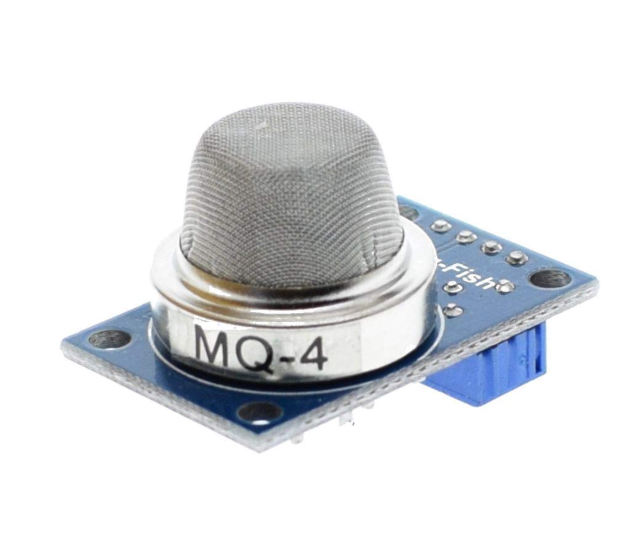
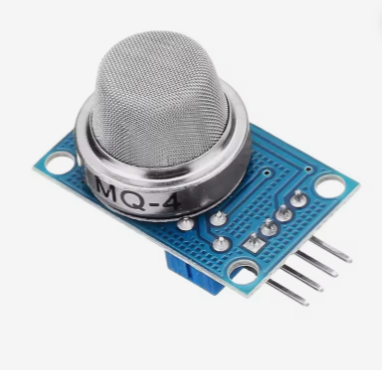
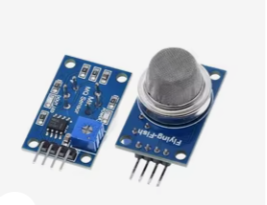
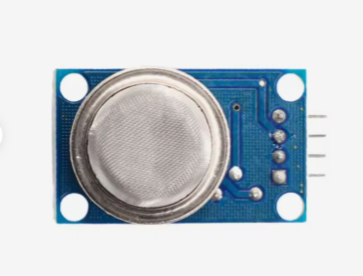
MQ-4 Methane and Natural Gas Sensor Module
= High-Sensitivity Semiconductor Gas Detector for Arduino =
The MQ4 gas sensor module is a costeffective, low-power device optimized for detecting methane (CH4) and natural gas (CNG). It uses a tin dioxide (SnO2) semiconductor, making it ideal for gas leak detection in home and industrial safety systems, with minimal sensitivity to alcohol, smoke, and cooking fumes .
Reliable Methane Detection - High sensitivity to CH4 from 300 to 10,000 ppm.
Dual Output Modes - Provides both analog (AO) and digital (DO) signals.
Operating voltage is 5V DC. The sensor requires a preheat time for optimal stabilization .
Use the onboard potentiometer to set the digital threshold sensitivity .
To estimate accurate ppm using the analog output, the sensor requires a calibration period in clean air .
= Technical Specifications =
| Parameter | Value |
|---|
| Target Gas | Methane (CH4), Natural Gas |
| Detection Range | 300 to 10,000 ppm |
| Operating Voltage | 5V DC |
| Heater Consumption | ~150 mA |
| Output Signal | Analog (AO) & Digital (DO) |
= Key Features =
High Sensitivity to CH4 - Excellent response to methane and natural gas.
Fast Response Time - Response time of <10 seconds .
Adjustable Sensitivity Builtin potentiometer for setting the digital trigger threshold .
Stable and Long Life - Reliable construction with stable characteristics.
Resistant to Interference - Low sensitivity to alcohol and cigarette smoke .
== Applications ==
- Household and industrial gas leak detectors .
- Methane concentration monitoring .
- Portable gas analyzers and safety devices.
- IoT and DIY environmental sensing.
Versatile Safety Component - Widely used for methane detection with Arduino.
Easy Arduino Integration - Simple wiring with analog and digital outputs.
√ On-board power and signal indicators.
√ 4 mounting holes for secure installation.
√ Compatible with Arduino, ESP32, and Raspberry Pi.
= Troubleshooting =
No output:
- Verify stable 5V power supply and connections .
- Ensure sufficient preheat time.
- Check the wiring (VCC, GND, AO, DO) .
Inconsistent readings:
- Adjust the sensitivity potentiometer .
- Avoid exposing the sensor to contaminants.
- Calibrate R0 for the environment .